Your Marketing Is Working. Your Digital Presence Isn’t.
You’re spending money on advertising. You’re getting attention. Customers are showing up, referrals are happening, and business feels busy.
So why does a competitor with a weaker product or service keep showing up above you online?
Here’s the uncomfortable truth for growing businesses: the operational side of growth often moves faster than the digital side. And by the time leadership notices the gap, customers — and revenue — have already slipped away.
The Moment It Costs You
Imagine someone searching for exactly what your business offers.
Maybe they need a contractor. A dentist. A law firm. A restaurant for a group event. A fitness studio. A local service provider. Whatever the industry, the pattern is the same.
They search online, compare a few businesses, and make a decision within minutes.
Your company might actually be the best fit. But they choose someone else because:
-
the competitor had stronger reviews,
-
their business information was accurate everywhere,
-
their website worked smoothly on mobile,
-
or they simply looked more responsive and established online.
Meanwhile, your listing had outdated hours, unanswered reviews, old photos, or a contact form nobody replied to quickly enough.
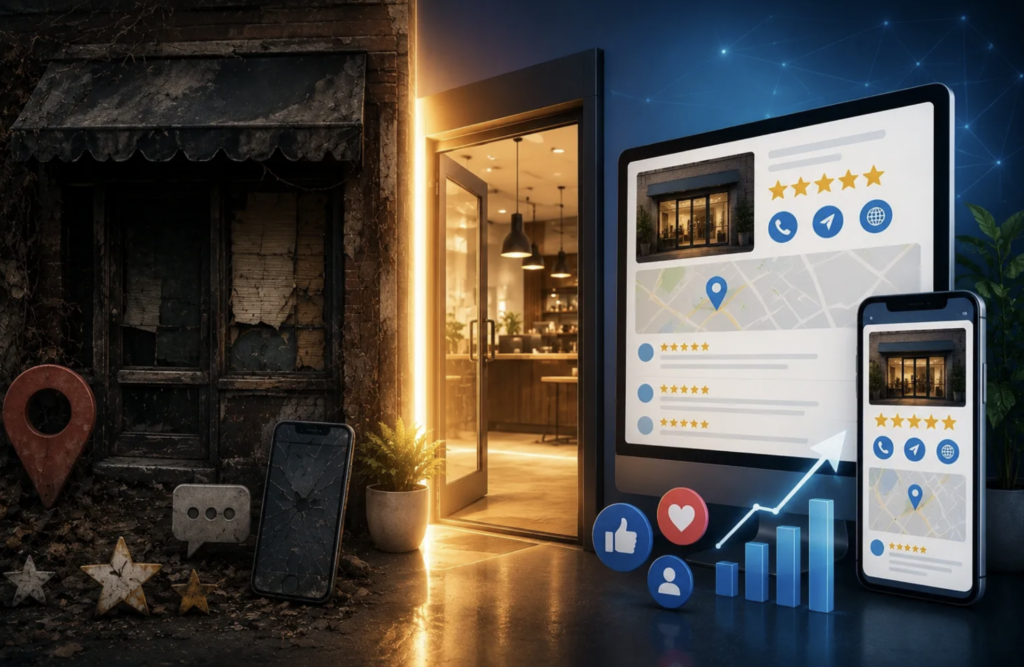
The business itself may be thriving. But the digital front door tells a different story.
What Actually Breaks as Businesses Grow
Growth creates complexity. What works for one location, one office, or one team often breaks once a business starts expanding.
Business listings drift over time. Hours become inconsistent. Old phone numbers stay live online. Duplicate listings appear. Customers get frustrated before they ever speak to someone on your team.
Reviews start piling up unanswered. Even great businesses can look disengaged when customer feedback sits ignored for weeks. Prospective customers notice that silence immediately.
Social media becomes inconsistent. Corporate messaging exists, but local engagement disappears. The communities businesses want to build online require consistent attention, and that becomes harder as operations scale.
Lead response times slow down too. Inquiries come in after hours or during busy periods, and nobody follows up until it’s too late. By then, the customer has already moved on.
Eventually, leadership loses visibility into what’s actually happening across the business. Decisions get made based on assumptions instead of reliable data because there’s no centralized view of customer interactions, reputation, marketing performance, and lead flow.
The Fix Usually Isn’t More Headcount
A lot of businesses try to solve these problems by simply adding more people.
But the companies that scale effectively usually focus on systems first.
That means:
-
automating review requests,
-
syncing business information across platforms,
-
creating consistent but locally relevant content,
-
improving response times with automation and AI,
-
and centralizing customer data so marketing, sales, and operations are connected.
The goal isn’t just efficiency. It’s consistency.
Customers should have the same high-quality experience whether they interact with your business in person, on Google, on social media, or through your website.
And those systems need to work not only for where the business is today, but for where it plans to be a year from now.
The Window to Fix It Is Earlier Than Most Companies Think
Most businesses wait too long to build the infrastructure that supports sustainable growth.
They wait until locations multiply. Until reviews become unmanageable. Until lead response becomes inconsistent. Until brand perception starts varying market to market.
By then, fixing the problem becomes far more expensive and time-consuming.
Your digital presence is often the very first interaction someone has with your brand. Long before they walk through the door, pick up the phone, or submit a form, they’ve already formed an opinion based on what they see online.
That experience should reflect the quality of the business itself.
If it doesn’t — or if you’re not sure — that’s usually a sign the underlying systems need attention.
Ready to fix what you didn’t even know was broken? Subscribe now.