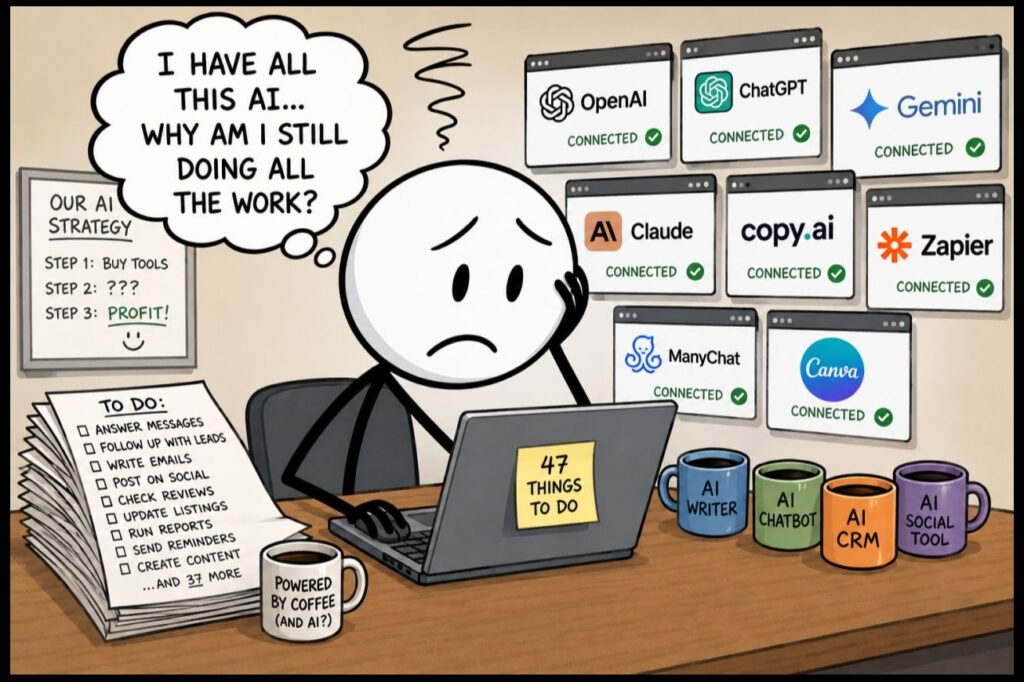
You bought the AI. You connected it to your marketing. You may have even told your team that things were about to get a whole lot easier. So why are you still doing everything manually? Bob is asking himself the same question.
He has an AI writer. An AI chatbot. An AI-powered CRM. He has tools that promise to automate his marketing, respond to customers, generate content and help his sales team follow up. Bob is, by all appearances, very much an AI guy now.
There’s just one small problem: Bob is still doing all the work.
And Bob isn’t alone. Businesses are adding AI to their marketing and sales stacks faster than they’re figuring out how to actually use it.
It’s easy to understand why. Every week there seems to be another tool promising to save hours, increase productivity and somehow transform the business while everyone is sleeping. So you sign up, connect an account, click a few buttons and wait for the magic to happen.
Then Monday arrives.
Someone still has to answer the customer messages. Someone still has to follow up with the leads. Someone still has to write the email campaign. Someone still has to figure out what to post on social media. Someone still has to look at the reports and decide what any of those numbers actually mean.
And somehow, that someone is still you.
The problem isn’t necessarily that your AI isn’t powerful enough. It’s that having AI and putting AI to work are two very different things.
Think about the tasks your marketing or sales team does over and over again. Responding to common questions. Following up with prospects. Drafting emails. Creating social posts. Summarizing reports. Organizing customer information. Asking for reviews. Those are exactly the kinds of repetitive tasks where AI and automation can make a real difference.
You don’t need to hand your entire business over to a robot named Steve.
You just need to stop making your employees do work that a computer can reasonably handle.
For example, imagine a prospect fills out a form on your website. Instead of that lead sitting in someone’s inbox until they remember to call, the information can automatically go into your CRM. An automated message can acknowledge the inquiry. The sales rep can get a notification. If the prospect doesn’t respond, the system can follow up again.
Nobody had to remember to do all of those things.
Or take customer messages. Instead of expecting someone to monitor Facebook, Instagram, text messages and other channels all day, AI can help organize and respond to routine questions while your team handles the conversations that actually require a human.
That’s where AI starts becoming useful—not when it produces a clever paragraph about your business, but when it quietly takes things off someone’s plate.
And that may be the biggest misconception about AI right now. Businesses don’t necessarily need more AI. They need to get more value from the AI and automation they already have.
Bob doesn’t need another subscription.
He needs his existing tools to start doing their jobs.
The good news is that getting there doesn’t have to mean a six-month technology project, a team of programmers or an afternoon spent watching 47 YouTube tutorials about “AI workflows for modern enterprises.”
Start with the boring stuff.
Look at the things your team does every day that are repetitive, predictable and time-consuming. Those are your opportunities. Automate one. Then another. Let AI handle the parts that don’t require a person, and let your people spend more time on the parts that do.
That’s a much more practical way to think about AI.
Because the goal isn’t to have the most AI tools.
The goal is to have fewer things on your team’s to-do list.
Don’t be like Bob. Don’t collect AI subscriptions just so you can tell everyone you’re “leveraging AI.”
Actually put the technology to work.
Learn more about how The DFM Agency helps businesses use AI, automation, CRM, social media and other digital marketing tools without making things unnecessarily complicated at DigitalFootprintManagement.com.