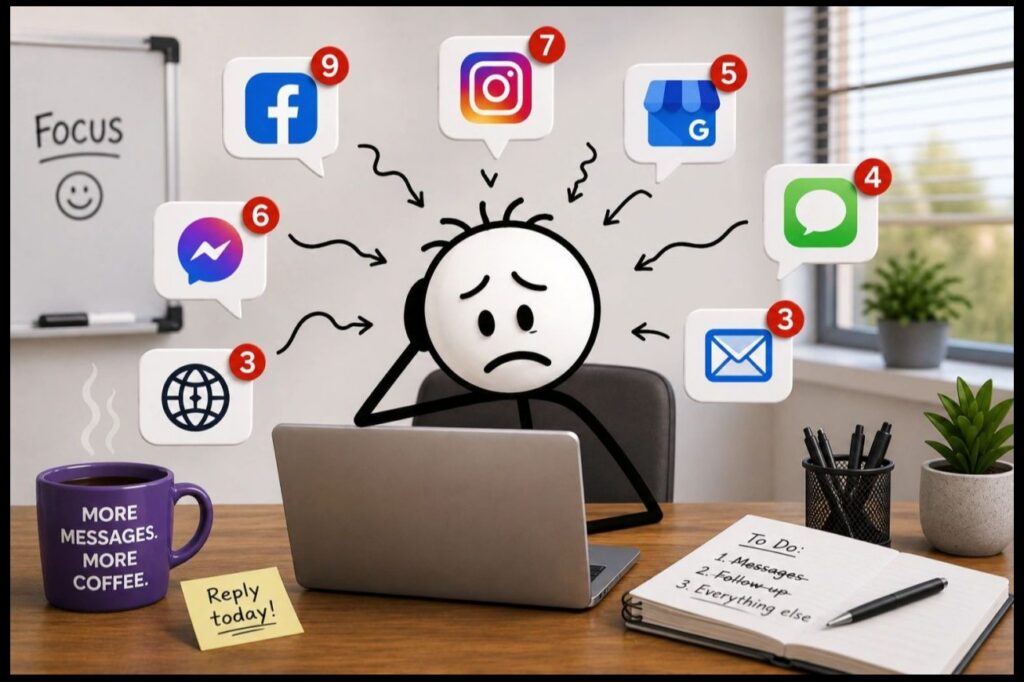
Somewhere out there, a customer is waiting for Bob to answer a message. Bob just doesn’t know where it is.
Poor Bob.
He started the morning with a pretty reasonable plan. Check email. Answer a few customer questions. Follow up with a couple of leads. Maybe get a social post scheduled before lunch. Simple enough.
Then he opened Facebook, logged in with two-party authentication, switched into the business page. There were messages, so Bob answered them.
Then he logged into and checked Instagram. More messages.
Then he remembered that customers can also reach the business through Google, so he logged in, checked there. More messages.
Then someone forwarded him an email from a customer who had apparently sent a message through the website yesterday. Bob sighed.
It’s not that Bob doesn’t want to respond. He knows those conversations matter. Anyone asking a question is potentially a customer ready to buy. Someone asking about hours, pricing, availability or an appointment probably shouldn’t have to wait until Bob finishes checking four different inboxes.
Bob has a problem.
His inbox isn’t actually an inbox. It’s a collection of places. And that’s how messages get missed.
It happens all the time. A customer sends a Facebook message while Bob is working on something else. An Instagram DM comes in after hours. Someone asks a question through the website while Bob is checking Google reviews. By the time anyone notices, several hours—or sometimes a day—have passed.
The customer isn’t thinking, “I’m sure Bob is very busy today.”
They’re thinking, “Why hasn’t this business answered me?”
Today’s customers have come to expect getting answers quickly. They don’t necessarily care which platform they used to contact you. They just know they asked a question and expect someone to respond.
That’s why bringing conversations together can make such a difference.
Instead of Bob having to remember which platforms to check, logging into multiple platforms, and remembering passwords, imagine giving him one place where those conversations come together. He can see what’s waiting, respond to customers, and keep the conversation moving without constantly opening another tab and remembering another login.
And this isn’t just about making Bob’s morning less frustrating.
It’s about making sure the business doesn’t miss opportunities.
Maybe that Instagram DM is from someone asking whether there’s an appointment available tomorrow. Maybe the Facebook message is someone asking if an item is in stock. Maybe the question coming through the website is from someone who is comparing your business with three competitors.
Those aren’t just messages.
They are opportunities to start a customer relationship.
This is also where AI can be genuinely useful—not as a replacement for Bob, but as a very capable assistant.
Instead of expecting Bob to personally handle every routine question at every hour of the day, an AI-powered conversation tool can help businesses respond to common customer questions, keep conversations moving and make sure customers aren’t greeted by digital crickets at 10:47 p.m.
The goal isn’t to make every customer conversation feel robotic. Quite the opposite.
It’s to handle the repetitive stuff so Bob has more time for the conversations that actually need Bob.
Think about a restaurant that gets the same questions every weekend: What are your hours? Do you take reservations? Where are you located? Do you have outdoor seating?
Or a service business that constantly gets asked: Do you service my area? How soon can someone come out? How do I schedule an appointment?
Bob shouldn’t have to stop what he’s doing 30 times a day to answer the same question.
And he definitely shouldn’t have to hunt through five different platforms to find the question in the first place.
This problem is solved with the DFM app.
Technology should help Bob do his job. It shouldn’t create more work for him.
Give him one place to manage conversations. Give customers a better chance of getting a timely response. Let AI help with the questions that don’t require a human. And when a conversation does need Bob, make sure Bob can actually see it.
The goal is not to eliminate the human from customer service. It’s to make sure the human is spending their time where it matters most.
So if Bob’s inbox currently looks like a game of digital Whac-A-Mole, maybe it’s time to give him some help.
And if you’re Bob?
We have a feeling you’re going to like this. See what DFM Conversations AI can do for your business.