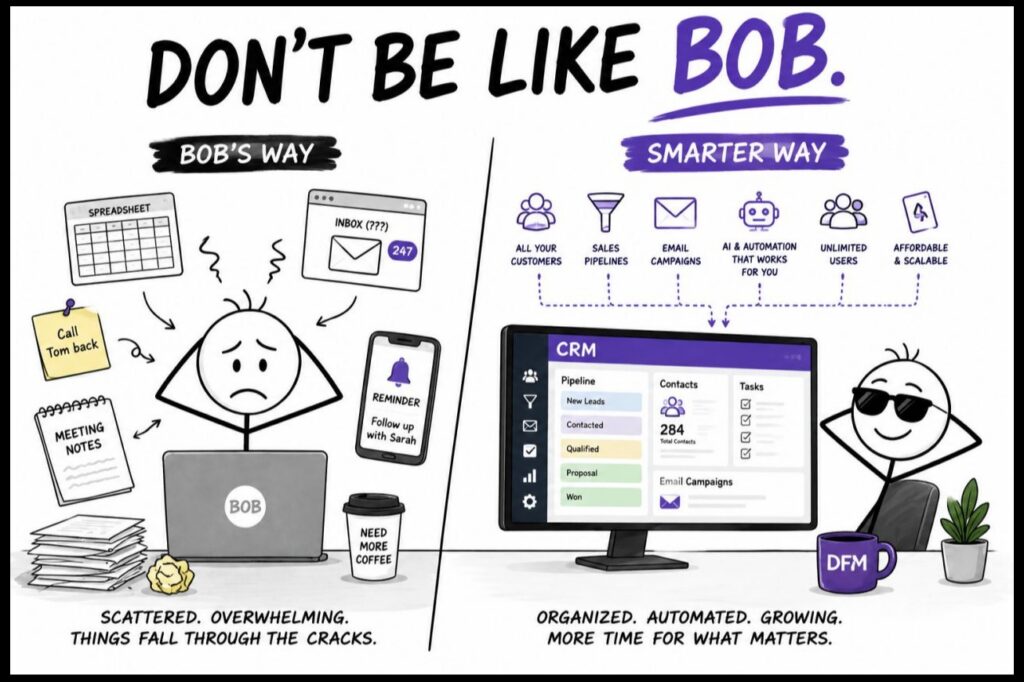
Poor Bob.
It’s Monday morning, and Bob is already behind.
His CRM is open on one monitor. Accounting is open on the other. He’s got the scheduling system pulled up in another tab, along with email, Google Analytics, a spreadsheet from last week, and a report someone sent him Friday afternoon with the helpful subject line, “Updated FINAL Report.”
There are also three tabs he refuses to close because he can’t remember why they’re open.
Then the boss walks by.
“Hey, Bob. How many new customers did we get last week?”
Bob stares at his screens.
“Give me a minute.”
And that’s how the next 20 minutes disappear.
If you’ve ever found yourself bouncing between multiple software programs just to answer what should be a simple question, you know Bob. Maybe you’re Bob.
Or maybe your Bob is Susan, Mike, Ashley, Steve—or an entire department of people spending valuable time moving information from one system to another.
The frustrating part is that none of these tools are necessarily bad. Your CRM might be great. Your accounting software might be great. Your scheduling system might be great. Your marketing platform might be great.
The problem is that they weren’t necessarily designed to work together.
So your employees become the integration.
They copy. They paste. They export. They import. They update spreadsheets. They send emails. They create reports. Then they do it all again next week.
And eventually someone says the sentence we’ve all heard before:
“There has to be a better way.”
That’s where things get interesting.
With Digital Footprint Management, have custom business applications that bring the information and processes your business relies on into a simpler, easier-to-use experience.
We’re not talking about replacing every piece of software your company already uses. In many cases, it’s quite the opposite. Your business has already invested in those systems. We can build an application that connects to them and pulls the information you actually need into one place.
Think about what that could mean for your team.
Instead of a sales manager checking the CRM, the calendar, email and a spreadsheet every morning, imagine opening one dashboard and immediately seeing what’s happening. Which leads came in yesterday? Who needs a follow-up? How many appointments are scheduled? Which salespeople are keeping up? Where are the opportunities being missed?
The same idea can apply to almost any part of a business. Maybe your managers spend hours every week putting together reports. Maybe onboarding a new employee involves sending a dozen emails, hunting down documents and hoping someone remembers to complete the checklist. Maybe your salespeople are constantly asking, “Where can I find that?” Or maybe you operate multiple locations and have no easy way to see how they’re performing side by side.
Those aren’t necessarily problems that require another off-the-shelf software subscription.
They may be problems that call for something built specifically around the way your business works.
And that’s the part we like.
Some of the best ideas for custom applications don’t start with a developer sitting in front of a computer. They start with someone inside a business saying, “Why are we still doing this manually?”
Maybe it’s the employee who spends every Monday morning compiling numbers from five different systems. Maybe it’s the office manager who maintains a spreadsheet that has somehow become mission-critical. Maybe it’s the owner who wants one place to see what’s happening across the company without asking three people to pull reports.
Those frustrations are opportunities.
A custom app can take a process that feels complicated behind the scenes and make it feel incredibly simple to the person using it. And you don’t have to know anything about app development to get started. You don’t need to come to us with a 40-page technical specification or a perfectly designed prototype. Just tell us what drives you crazy.
Tell us what your employees spend too much time doing. Tell us what information you wish you could see in one place. Tell us about the spreadsheet everyone depends on or the report that takes half a day to create.
We’ll explore what might be possible.
Because maybe your business doesn’t need another piece of software.
Maybe it needs your software.
So the next time you catch yourself saying, “There has to be an easier way to do this,” don’t ignore it.
That’s often where the best ideas start.
You bring the problem.
We’ll help build the solution.
And Bob? Bob can finally close those 14 browser tabs.