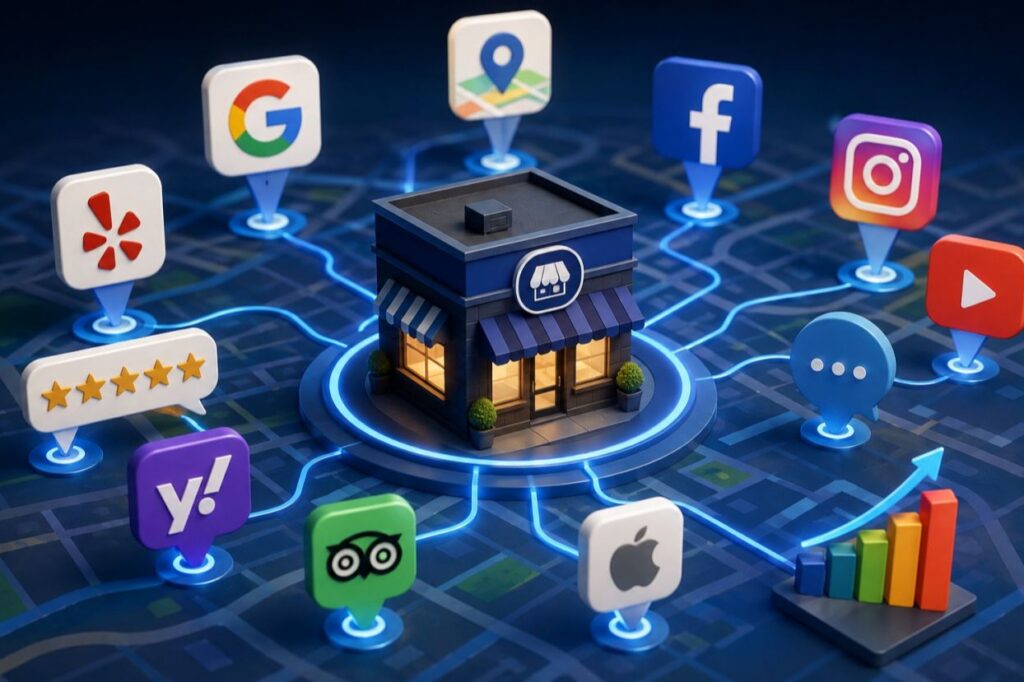
For years, business owners have been told that their website is the center of their online presence. And honestly, that made sense. Build a good website, make sure it shows up in Google, keep the information current, and send customers there when they want to learn more.
Simple enough.
Except there’s one small problem: your website isn’t the only place people—or technology—are looking anymore.
Your business now exists in dozens of places online. Google. Apple Maps. Facebook. Instagram. Yelp. TripAdvisor. Industry directories. Review sites. Local listings. Videos. News articles. And increasingly, AI tools like ChatGPT and Gemini.
That can feel a little overwhelming when you’re already trying to run the actual business.
You know the feeling. You open your laptop intending to answer three emails, and two hours later you’ve updated your Google hours, answered a Facebook message, tried to figure out why your address is wrong on Apple Maps, responded to a review from someone who apparently had a completely different experience than everyone else, and somehow still haven’t answered the original three emails.
Welcome to being a business owner in 2026.
Your customers aren’t all looking in the same place
The way people discover businesses has changed. Someone might search Google for a nearby restaurant. Someone else might ask ChatGPT which local company can solve a particular problem. Another person might see a recommendation on Facebook or Instagram. Someone else might check Google reviews before ever visiting your website.
And AI is making this even more interesting.
Google has connected Gemini directly with Google Business Profile, giving Gemini access to information such as business reviews, customer questions and performance data. Business owners can use Gemini to analyze performance, draft review responses and make certain profile updates.
OpenAI is also building increasingly sophisticated discovery experiences into ChatGPT. The company has described people using ChatGPT to explore, compare and decide what to buy, while its newer local-services capabilities allow participating businesses to potentially connect customers with quote-request experiences directly inside ChatGPT.
In other words, the customer journey is becoming less about finding your website and more about finding information about your business.
And that distinction matters.
AI can’t recommend what it can’t understand
Think about your online presence as a giant digital puzzle.
Your website is one piece. Your Google Business Profile is another. Your reviews are another. Your social profiles, business directories, photos, hours, services and other online references are all additional pieces.
When those pieces agree, it’s easier for both people and technology to understand who you are, what you do, where you’re located and what customers think about you.
When they don’t, things get messy.
Maybe your website says you’re open until 7:00, but Google says 6:00. Your Facebook page still lists an old phone number. Your address is formatted differently on three directory sites. Your Instagram hasn’t been updated since the holidays. Your Google reviews have 47 unanswered questions sitting there like tiny digital ghosts.
None of those things feels like a crisis when you’re looking at them individually.
Together, though, they create a pretty confusing picture of your business. And that’s becoming increasingly important as AI systems rely on information from across the web to answer questions and help people make decisions.
This is where the “digital footprint” comes in
Your digital footprint is everything your business leaves behind online.
It’s not just your website. It’s the collection of information, content, reviews, profiles and mentions that tell the internet—and ultimately your customers—who you are.
That’s why keeping your digital footprint accurate isn’t just an SEO exercise anymore. It’s basic business housekeeping.
The problem is that most business owners don’t have time to spend their afternoon playing Where in the Internet Is My Business Information Wrong?
You have employees to manage. Customers to call. Invoices to approve. Inventory to order. Payroll to deal with. Marketing to think about. And, if you’re really lucky, lunch.
You shouldn’t need six browser tabs, three passwords you can’t remember and a spreadsheet named “FINAL LISTINGS UPDATED 2026 FINAL FINAL” just to keep your business information consistent online.
The good news? You don’t have to manage everything manually.
Technology has gotten better at helping businesses manage all of this information from fewer places.
That’s one of the reasons we built DFM around the idea that managing your digital footprint shouldn’t require hiring an agency—or becoming a full-time digital marketing manager yourself.
The DFM Agency helps businesses manage the information customers find across search, maps, directories, social platforms and reviews from one place. DFM
The goal isn’t to make you spend more time thinking about your digital footprint. It’s to make sure you don’t have to.
Because your website still matters. A lot. But in 2026, your website is just one chapter of the story your business is telling online.
Your customers are reading the rest of the story in Google, Maps, social media, reviews and increasingly in conversations with AI. So the real question isn’t, “Is my website good enough?” It’s “Does everything people—and AI—find about my business tell the same story?” That’s your digital footprint. And it’s probably bigger than you think.
Learn More
Want to see how DFM can help you manage your digital footprint without adding another full-time job to your already full-time job?