What this means for your business.
If you got the email from OpenAI announcing “shopping research” in ChatGPT — or you’ve seen customers mention it — here’s the short version: ChatGPT can now act as a personal shopping assistant. A customer describes what they want, and ChatGPT goes out, researches products across the internet, compares reviews, weighs tradeoffs, and hands back a personalized buyer’s guide in a few minutes.
No scrolling through a dozen tabs. No skimming 400 reviews. No comparing spec sheets side by side. The AI does all of it — and then tells the shopper what to buy and where to buy it.
If you sell anything — vehicles, boats, RVs, appliances, services, experiences — this changes how customers find you. Let’s break down what shopping research actually is, how people are using it, and what your business needs to do to show up in the answers.
What Is ChatGPT Shopping Research?
Shopping research is a feature inside ChatGPT designed for deeper buying decisions. Instead of a quick one-line answer, the AI runs a multi-step research process on the shopper’s behalf.
Here’s how a typical session works:
-
The shopper describes what they need in plain language. Something like, “I need a lightweight stroller that can handle city sidewalks on a mid-range budget,” or “Help me find a gaming laptop under $1,000 with a screen over 15 inches.”
-
ChatGPT asks clarifying questions — budget, who it’s for, which features matter most. If the shopper has memory turned on, it also factors in what it already knows about them from past conversations.
-
The AI researches across the internet in real time, pulling current prices, availability, specs, images — and reviews. The shopper can steer as it goes, marking options as “not interested” or “more like this.”
-
The shopper receives a personalized buyer’s guide: top products, key differences, tradeoffs, and links to retailers.
OpenAI says the feature performs especially well in detail-heavy categories — electronics, home and garden, kitchen and appliances, sports and outdoor. In other words, exactly the kind of considered purchases where buyers used to spend hours on Google, review sites, and forums.
And this is rolling out to everyone — free users included. This isn’t a niche power-user tool. It’s the new default way millions of people will research what to buy.
How People Will Actually Use It
Think about the last considered purchase you made. You probably searched Google, opened a few review sites, checked a YouTube comparison, read some Reddit threads, and cross-referenced prices. Shopping research collapses all of that into one conversation.
Real-world examples of how shoppers are using it:
-
Comparing specific options. “Compare these three models and tell me the best fit and tradeoffs.” The AI reads the reviews and spec sheets so the buyer doesn’t have to.
-
Discovering products they didn’t know existed. “Find me the quietest cordless vacuum for a small apartment.”
-
Gift shopping. “I need a gift for my dad who loves fishing but never catches anything.”
-
Deal hunting. “Find the best price on these sneakers and tell me if I qualify for any discount codes.”
Notice what’s happening in each of these: the shopper never visits your website during the research phase. The AI visits it for them. The AI reads your product pages, your reviews, your listings — and decides whether you make the shortlist.
By the time a human lands on your site, the decision is mostly made.
Why Reviews Just Became Even More Valuable
Here’s the part of OpenAI’s announcement that every business owner should read twice: shopping research results are organic. There’s no ad placement. The AI reads publicly available pages, cites reliable sources, and — critically — avoids low-quality or spammy sites.
So what determines whether your business shows up in an AI-generated buyer’s guide? The same signals AI models trust everywhere else:
-
Your review profile. Volume, recency, star rating, and — increasingly important — the content of your reviews. When ChatGPT compares options, it’s synthesizing what real customers said. If your reviews mention slow service or a pushy sales process, the AI reads that. If they mention a smooth buying experience and a great service department, the AI reads that too.
-
Your responses to reviews. A business that responds thoughtfully to feedback — including negative feedback — signals legitimacy and care. A wall of unanswered one-star reviews signals the opposite.
-
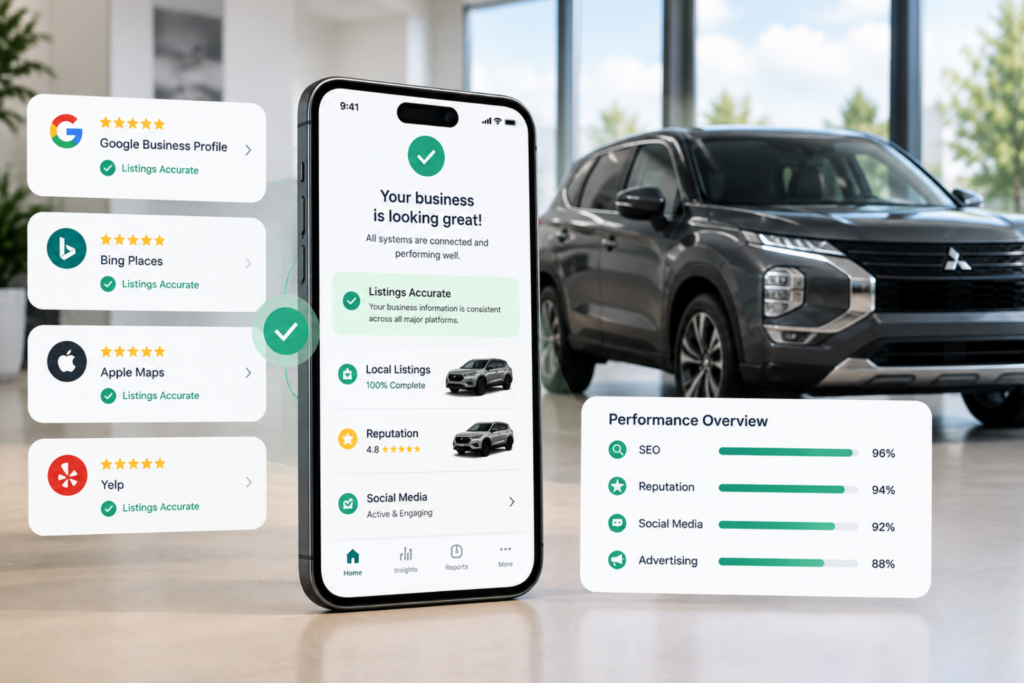
Accurate, consistent listings. AI tools cross-reference your business information across the web. If your hours, address, phone number, or inventory details don’t match from one platform to the next, you look unreliable — and unreliable sources get skipped.
-
Structured, crawlable product and service pages. If an AI can’t cleanly read your pricing, specs, and availability, it can’t recommend you. It will recommend the competitor whose site it can read.
This is the shift we’ve been telling clients about for over a year: your digital reputation is no longer just influencing human buyers — it’s the raw data an AI uses to decide whether you exist.
What This Means for Local and Multi-Location Businesses
If you run a dealership, a marine or RV operation, a service business, or a multi-location group, you might be thinking this only affects e-commerce brands selling vacuums and strollers. It doesn’t.
Shopping research is one feature in a much bigger pattern. Google’s AI Mode, Perplexity, Gemini, and ChatGPT are all moving toward the same model: the AI does the research, and the customer sees a synthesized recommendation. “Best GMC dealer near me,” “most trustworthy RV service center in the area,” “boat dealer with the best reviews” — these questions are already being answered by AI, using your reviews and listings as the source material.
And here’s the uncomfortable truth: you can’t buy your way into these results. There’s no ad budget that fixes a weak review profile or inconsistent listings. The businesses that win AI recommendations are the ones whose digital foundations were already strong before the AI came looking.
How to Get Your Business AI-Ready
The good news? The playbook isn’t a mystery. It’s the fundamentals, executed consistently:
-
Build review velocity. A steady stream of recent reviews beats a big pile of old ones. AI models weight recency heavily — a business with 40 reviews from the last 90 days looks more alive than one with 400 reviews from 2022.
-
Respond to every review. Yes, every one. Responses are content the AI reads, and they demonstrate an engaged, accountable business.
-
Audit your listings. Every directory, every platform, every map service. Name, address, phone, hours, categories — identical everywhere.
-
Address negative feedback at the source. One unresolved complaint thread can surface in an AI summary for months. Reputation problems don’t age out anymore; they get indexed.
-
Monitor how AI describes you. Ask ChatGPT, Gemini, and Perplexity about your business and your category. What they say today is what your next customer hears tomorrow.
For most business owners, the honest obstacle isn’t understanding this list — it’s finding the time to execute it every single week while running the actual business.
Where DFM Comes In
This is exactly the work The Digital Footprint Management Agency does every day. Our app manages review generation and responses, keeps listings accurate across the entire web, monitors what AI tools are saying about your business, and builds the kind of digital presence that earns a spot in AI-generated recommendations — whether that’s a ChatGPT buyer’s guide, a Google AI Mode answer, or whatever launches next quarter.
The businesses showing up in AI shopping results six months from now are the ones doing the reputation work today. The window to get ahead of this is open — but it won’t stay open forever, because your competitors are reading the same announcements you are.
Ready to find out how your reputation looks through an AI’s eyes?